How to follow up a valuation that didn’t instruct
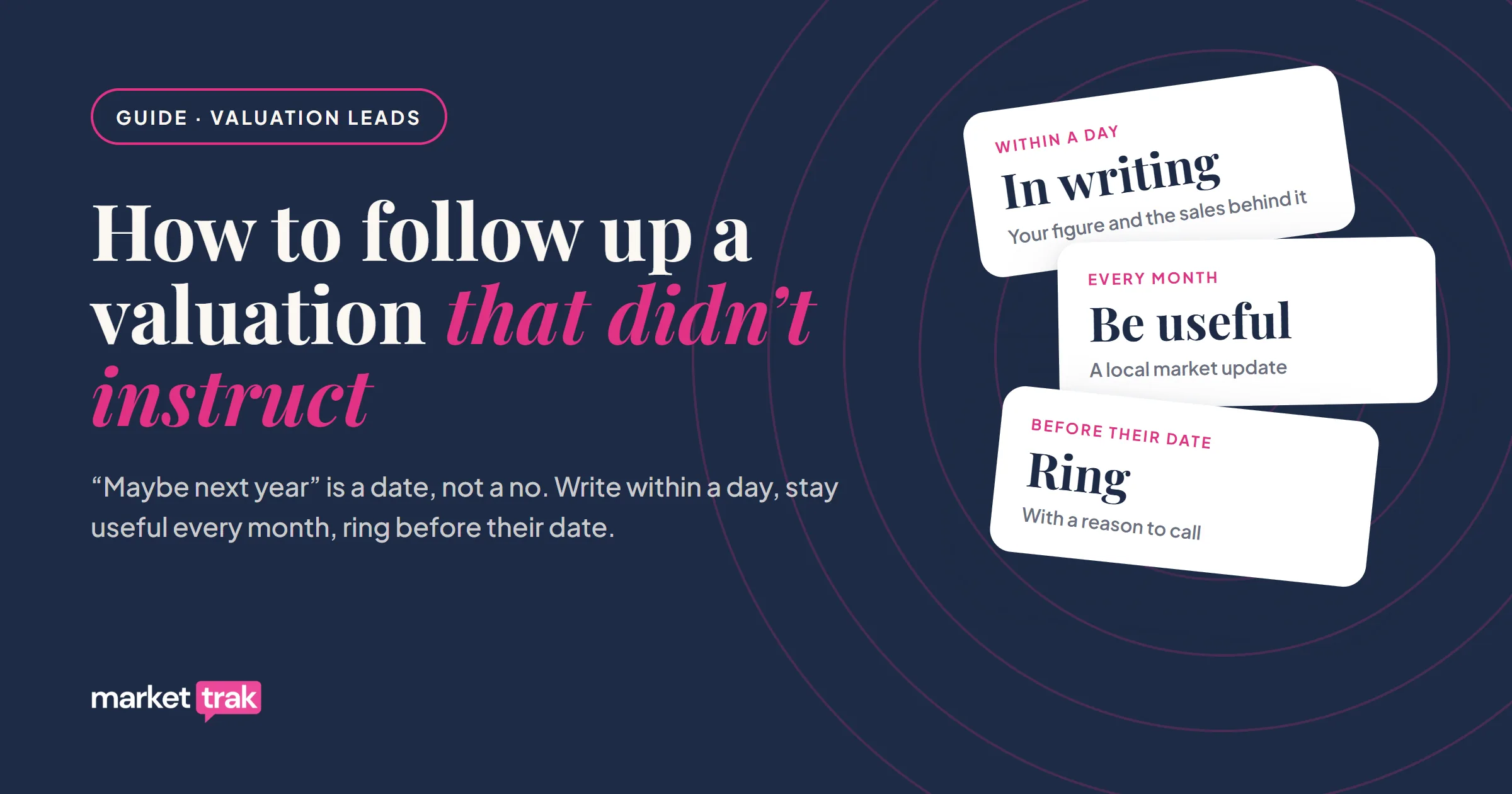
To follow up a valuation that didn’t instruct, treat “maybe next year” as a date, not a no. Put your figure in writing within a day, ask how they’d like you to keep in touch, send them something useful about their area every month, and ring a few weeks before the time they gave you.
Why “maybe next year” is worth chasing
Half three on a Thursday. You’ve just left a three-bed semi in Didsbury. Lovely couple, kettle on, and they seemed happy with your figure. Then the line you’ve heard a hundred times: “We’ll probably wait until the spring, once the kids have done their exams.”
You type it into the notes back at the office, and for most agents that’s where it ends. Nobody rings in March. In April the house goes on with whoever kept in touch.
Which is a shame, because a homeowner who’s had you round and liked you is about as warm as a lead gets. They’ve let you in. They know your face.
People don’t move often, either. The English Housing Survey for 2023 to 2024 found owner occupiers had lived in their current home for 17.2 years on average, and 9.3 years for those still paying off a mortgage. So when someone who’s been there a decade says “next year”, it’s usually a real plan rather than a brush-off.
You won’t be the only agent in the running when the time comes, mind. When Zoopla and YouGov asked 1,006 homeowners who’d sold in the last five years, 49% said they’d get round three different agents to value. Many homeowners choose their agent long before they sell, so the months between now and the spring are where this one’s won or lost.
Within a day: put your figure in writing

Send a written follow-up the next working day, while the visit’s still fresh. Email’s fine. A letter as well is a nice touch if that’s your style. Keep it to what they’ll want to look back at in March:
- the price you’d put it on at, and what you’d expect it to sell for
- two or three recent sales you based it on, using sold prices rather than asking prices
- anything you’d sort before it went on, like the front garden or a lick of paint in the hall
- the timing they mentioned, in their words, so they can see you listened
Then ask one question. How would they like you to keep in touch? Zoopla’s November 2025 survey of 1,000 homeowners who’d sold found phone calls were the most popular way to hear from an agent (63%), then email (56%) and meeting in person (40%). Only 25% picked text or messaging. Some people want a call, some want to be left alone until they ring you. Ask, write the answer down, and stick to it.
Put the date and the reason in your notes the same day. “Spring, after exams, want a bigger garden” is worth far more in March than a name and a number. If they came in through your instant valuation tool they’re already in your Market Trak leads list. If you met them another way, add them as a lead yourself and put it in the notes there.
Between now and then: one useful thing a month
This is where most follow-up goes wrong. The agent either vanishes for nine months or rings every few weeks to ask if they’re ready yet. Neither does you any favours.
What works is turning up regularly with something worth reading. In the same 2025 Zoopla research, the top reason homeowners gave for choosing an agent was a good local presence and selling other homes in the area (20%). Next came being well known locally for their expertise, by word of mouth (13%). Being useful every month is how you build both.
A local market update does most of the work: what’s sold nearby, how prices are moving in their area, what you’re seeing at viewings. Our guide to what goes in a local market update covers what to put in it. Add a quick note when you sell something near them, and that’s it. They asked for a valuation, not a newsletter every Tuesday.
Ask before you add anyone to a monthly email, either at the valuation or in your follow-up, and note the yes. In Market Trak, any lead in your list can be sent a local market update every month, so the couple who said “spring” in November get four or five months of hearing from you before they pick up the phone to anyone.
Ring before their date, with a reason

If they said spring, don’t wait until spring. By then they may already have rung round. Our rule of thumb is six to eight weeks before the time they gave you. That’s ours rather than something from a study, but it’s early enough to be first and late enough that they’re thinking about it.
Give yourself a reason to ring. “Just checking in” invites “not yet, thanks”. Something like this is better:
“Hi Sarah, it’s Sam from Hartley and Co. You mentioned you might look at moving after the exams, so I thought you’d like to know we’ve just sold a three-bed a couple of roads from you. Happy to pop round and refresh your figure if that’s useful?”
If prices have moved since your visit, that’s a reason too. A fresh figure gets you back through the door, and this time they’ve already met you.
Whatever they say, update the notes. “Not until the summer now” is just a new date. Move it and carry on.
If they go quiet, or go with someone else
Not every “next year” turns into an instruction with you. Plans change, and sometimes they’ll pick another agent. If they go quiet, keep the monthly update going and leave the phone alone until there’s a real reason to ring. There’s more on that in our guide to what to do when a valuation lead won’t answer.
If they instruct someone else, send one short note wishing them luck with the sale. No sulking, and no “if it doesn’t work out, give us a ring”. It costs you nothing, and it’s the last thing they’ll remember about you.
Keep them on your update if they’re happy to stay on it. They’ll move again one day, and in the meantime their neighbours will ask who they’d recommend. The rest of the approach, from first enquiry to instruction, is on our lead generation for estate agents page.